


When India and the United States announced a breakthrough trade agreement this week after months of tense negotiations, tariffs dominated the headlines. But beneath the numbers and celebrations lay another issue that is far more political than commercial – oil — who India buys it from, and who it is expected to buy from in the future.US President Donald Trump claimed that as part of the agreement, India had agreed to halt purchases of Russian crude and would instead buy oil from the United States and potentially Venezuela. India has not publicly confirmed any such commitment, and Russia has said it has received no official communication from New Delhi. Yet, this highlights a recurring reality of global diplomacy; oil is not merely a traded commodity; it is a strategic instrument that shapes alliances, sanctions, wars and trade deals.The India–US trade deal has brought this dynamic into sharp focus, placing energy security and geopolitics alongside tariffs, supply chains and market access.

The trade deal that reset ties
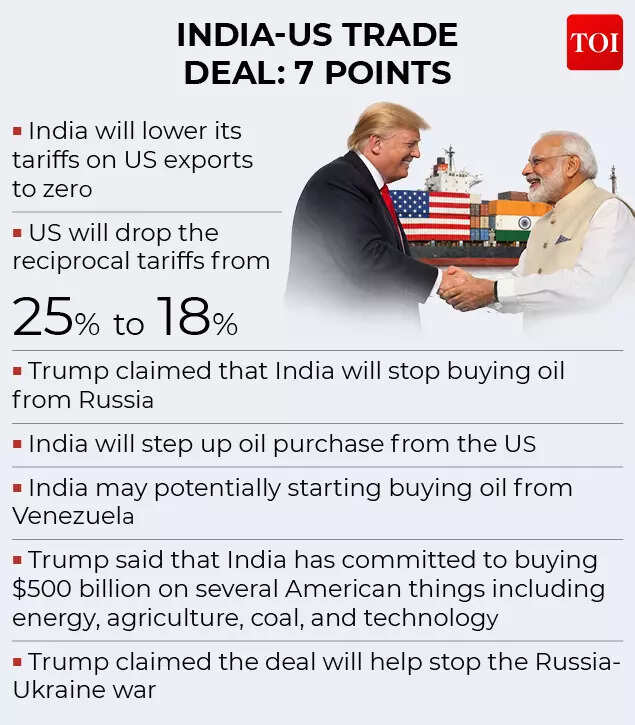
US President Donald Trump and Prime Minister Narendra Modi took many by surprise when they suddenly announced a trade deal that will lower tariffs on Indian goods entering the US to 18 per cent, down from 50 per cent; while according to Trump’s claims India drops tariffs to zero. While the agreement is yet to be formally signed and finer details are still being worked out, it effectively ends a prolonged stalemate and restores predictability to trade ties.

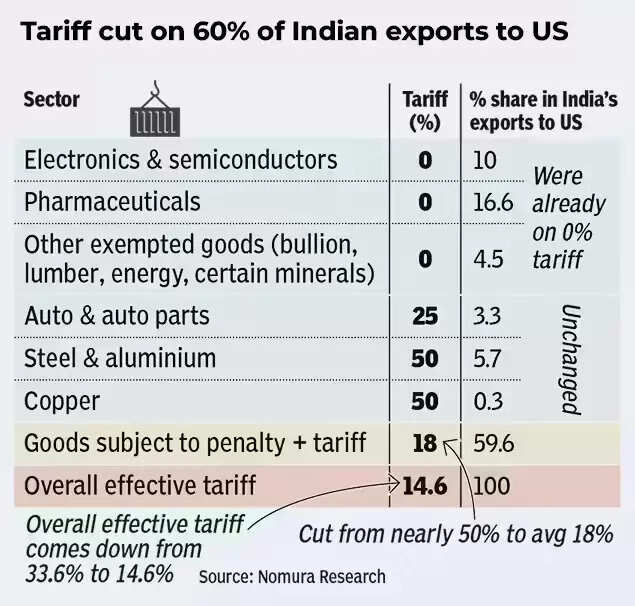
Talking about the benefits of this deal, Rudra Kumar Pandey, partner at Shardul Amarchand Mangaldas & Co, told TOI, “The US decision to reduce tariffs on Indian goods to a headline rate of 18 percent marks a clear de-escalation in bilateral trade frictions and reflects aligned strategic intent on both sides. The move reinforces India’s export-competitive posture, supported by recent customs duty rationalisation, and comes amid a broader US supply-chain recalibration away from China.”“What is particularly encouraging is that Indian industry has already demonstrated resilience through market diversification. Exports to Spain, for instance, reportedly rose by over 56 percent to about USD 4.7 billion during April–November FY 2025–26, underscoring the ability of Indian exporters to scale in alternative markets. The reopening of the U.S. market, alongside improving access to Europe through the momentum of the India–EU trade agreement, positions these sectors to return to a stronger and more sustained growth trajectory,” he further added.The US is India’s single largest trading partner, and the steep tariffs imposed by the Trump administration had hurt Indian exporters. With the rate now cut to 18%, India will regain competitiveness in the US market, particularly across labour-intensive sectors such as garments, leather, footwear, carpets, seafood and gems and jewellery.Talking about the impact on exports, Rudra Kumar Pandey said, “The immediate gains will be concentrated in tariff-sensitive and labour-intensive sectors that are most responsive to marginal duty changes. Textiles and apparel, gems and jewellery, leather and footwear, engineering goods, and auto components stand to benefit disproportionately, as these sectors compete directly with Vietnam and Bangladesh in the US market. Lower effective tariffs improve India’s relative cost position and are likely to translate quickly into higher order flows and sourcing diversification in India’s favour.”Further explaining the trade equation between India and US he added, export performance toward the US has already shown considerable strength despite the phase of heightened trade tensions. Shipments rose 11.3 per cent to about $59 billion between April and November 2025, with smartphone exports alone doubling to $16.7 billion. Bringing tariffs down to an effective rate of roughly 18 percent is expected to consolidate these gains and support sustained export growth across a range of manufacturing sectors, according to Pandey.India has also committed to buy American goods worth $500 billion, according to Trump. Sharing his insights on that, the Shardul Amarchand & Co partner said, “The announcement that India could import up to $500 billion of goods from the United States forms an explicit part of the broader tariff-reset package and underscores the strategic balance of the agreement. The expansion of imports is expected to be concentrated in energy, advanced technology, and capital goods, including LNG and crude oil, industrial machinery, aircraft components, and defence-related platforms. Greater access to US energy supports India’s supply diversification objectives, while increased inflows of high-value capital equipment and technology strengthen domestic manufacturing capability and productivity. Together, these measures anchor a more strategic and mutually reinforcing bilateral trade relationship with clear net gains for India”Meanwhile, Commerce minister Piyush Goyal has described the agreement as a “very good” deal, noting that India now enjoys tariff treatment comparable to — or better than — its regional competitors. India’s new tariff rate is lower than Vietnam (20%), Bangladesh (20%), Malaysia (19%), Cambodia and Thailand (19%), and far below China’s 34%. It is also lower than Pakistan’s 19%.
Where oil enters the picture
While tariffs were the centrepiece of the deal, Trump’s Truth Social post pointed to a broader geopolitical bargain. “We spoke about many things, including Trade, and ending the War with Russia and Ukraine. He agreed to stop buying Russian Oil, and to buy much more from the United States and, potentially, Venezuela,” Trump wrote.The claim immediately raised questions. India has not announced any decision to stop buying Russian crude. Russian officials, too, have said they are unaware of any such move. Kremlin spokesperson Dmitry Peskov said Moscow had not received any official communication from New Delhi and that Russia intended to continue strengthening ties with India across all areas of cooperation.MEA on Thursday also addressed the question of where India will buy the oil from emphasising on energy security.

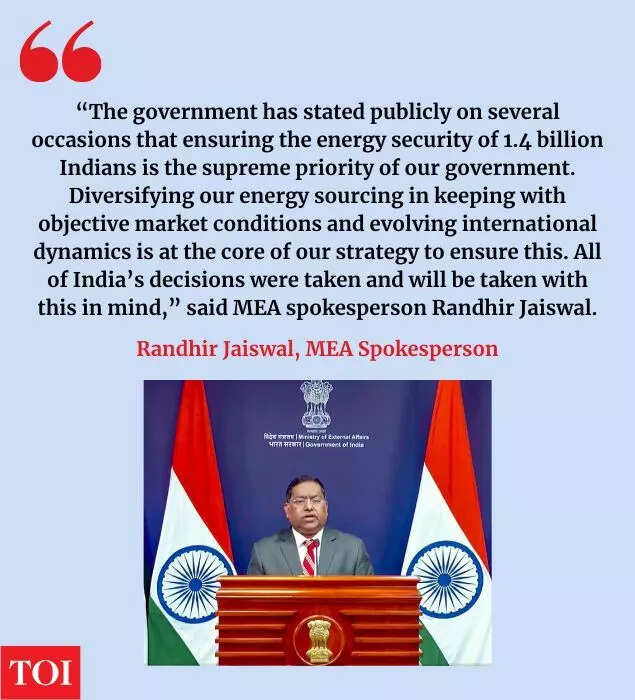
Indian refiners have also indicated that they have received no directive from the government to halt purchases of Russian oil. According to refinery sources quoted by Reuters, any winding down of existing transactions would require time, given contracts already under way.
Why oil remains a strategic commodity?
Oil is not merely another import commodity. It is the backbone of transport networks, industrial production, defence preparedness, inflation control and overall economic stability. In the case of major and rapidly growing economies like India, the availability of cheap and assured oil supplies is critical to maintaining growth momentum, managing price pressures, and securing energy security, especially amid the current geopolitical uncertainties in various parts of the world.At the same time, for global powers such as the US, oil supplies are a highly effective tool of foreign policy. Sanctions, trade agreements, and diplomatic maneuvering are commonly used to determine where countries procure their energy from and at what prices. This has been apparent in US sanctions imposed on Russian oil traders, as well as in Washington’s constant attempts to deny the revenue base of its adversaries by limiting their access to the global energy market.In this context, oil becomes inseparable from diplomacy. Energy sourcing decisions are no longer strictly commercial or technical considerations, but more of a measure of strategic alignment and geopolitical positioning. Consequently, trade talks, sanctions policy, and foreign policy are increasingly shaped by energy considerations, sometimes just as much as tariffs or free market access.
India’s reliance on Russian crude
Since Western sanctions intensified following the Russia–Ukraine war, India sharply increased its intake of discounted Russian crude, particularly the Urals grade. The discounts made Russian oil economically attractive, especially for India’s complex refining system, which is well-suited to processing such grades.However, data show that Russian oil imports have already been declining. According to Kpler, Russia’s share of India’s crude imports fell to 33.7% between April and November 2025, from 37.9% in the same period the previous year. In absolute terms, Russian crude imports dropped from about 1.8 million barrels per day in November to 1.2 million barrels per day in December, and further to 1.16 million barrels per day in January 2026.Over the same period, the US share of India’s crude imports rose from 4.6 per cent to 8.1 per cent.

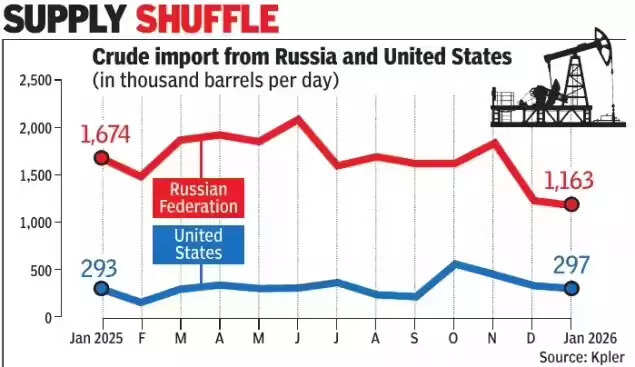
Despite this trend, analysts caution against reading the trade deal as an immediate turning point. Sumit Ritolia, lead research analyst at Kpler, said Russian volumes are largely locked in for the next 8–10 weeks and remain economically critical for India. He added that Russian imports are likely to remain broadly stable through the first half of 2026–27, with any moderation being offset by higher inflows from West Asia.
Can the US and Venezuela replace Russian oil?
Donald Trump claimed that India would substitute Russian oil with supplies from the US and/or Venezuela. While US crude exports to India have already been rising, Venezuelan oil presents a more complex picture.A recent report by SBI Research estimated that India could save almost $3 billion per year by replacing a portion of its Russian oil imports with Venezuelan heavy oil, if it is available at a discount of $10-12 per barrel. Venezuelan heavy oil is currently trading at around $51 per barrel, as per Oil Price information cited in the report.However, the real gains would depend on a number of factors, such as the distance and logistics of transporting the oil, insurance costs, and the refinery’s ability to process the Venezuelan heavy oil. Only Reliance Industries and Nayara Energy have the capacity to process large quantities of Venezuelan oil, while state-owned refineries would struggle to replace even 10% of their current Russian oil imports, according to refinery officials cited by ReutersThis means any shift in sourcing would likely be gradual and partial, driven by commercial feasibility as much as diplomatic signalling.
Energy security
The India–US trade deal brought significant economic benefits, including the reduction of tariffs on almost 60% of Indian exports to the US. Goldman Sachs projected an additional GDP growth of 20 basis points if the reduced tariffs are strictly applied, while Barclays estimates the effect at 30 basis points.Markets responded positively, with a sharp rally in equities and a strong appreciation of the rupee right after the announcement. Investor sentiment also improved as uncertainty receded to a large extent.Yet the oil question introduces a layer of strategic complexity. India has maintained a balance in its relations, strengthening ties with the US while continuing to cooperate with Russia, with whom it has been associated for a long time, and managing its energy dependencies in West Asia, Africa, and South America.For New Delhi, oil buying has been primarily guided by energy security and cost considerations. For Washington, energy sourcing is mostly linked to broader geopolitical objectives, including sanctions enforcement and pressure on adversaries.
It all comes back to oil
The India-US trade agreement is a reminder that in today’s world of geopolitical uncertainties and fragmented global supply chains, oil is a crucial bargaining chip. It is a commodity that finds itself at the intersection of politics, economics, and security.While the minute details of the trade agreement are still being worked out, this much is clear: oil will continue to be a factor not only in trade agreements but in the overall politics of power. For a country like India, this will continue to be a tricky tightrope walk between strategic autonomy and economic pragmatism.
Oil wars
Oil, being a centre point in international relations, is not restricted to India. In fact, it has been at the heart of some of the world’s most consequential wars and geopolitical confrontations. Most recently, In Venezuela, less than a month after a US military operation resulted in the capture of President Nicolás Maduro and his wife, lawmakers in Caracas approved a landmark law opening the country’s long state-controlled oil sector to private and foreign companies, a reversal of more than two decades of nationalisation aimed at enticing US and other investors.The move follows pressure from the Trump administration, which has eased some sanctions and signalled strong involvement of American energy firms in revitalising Venezuela’s oil production, showing how control over crude reserves remains a core strategic objective for global powers.Moreover, for over a century, nations have gone to war, altered military strategies or imposed sweeping sanctions to secure access to oil fields or prevent rivals from controlling a resource that fuels modern economies and armed forces. Control over oil has often meant control over industrial output, military mobility and economic survival, turning energy into a strategic objective rather than a commercial asset.

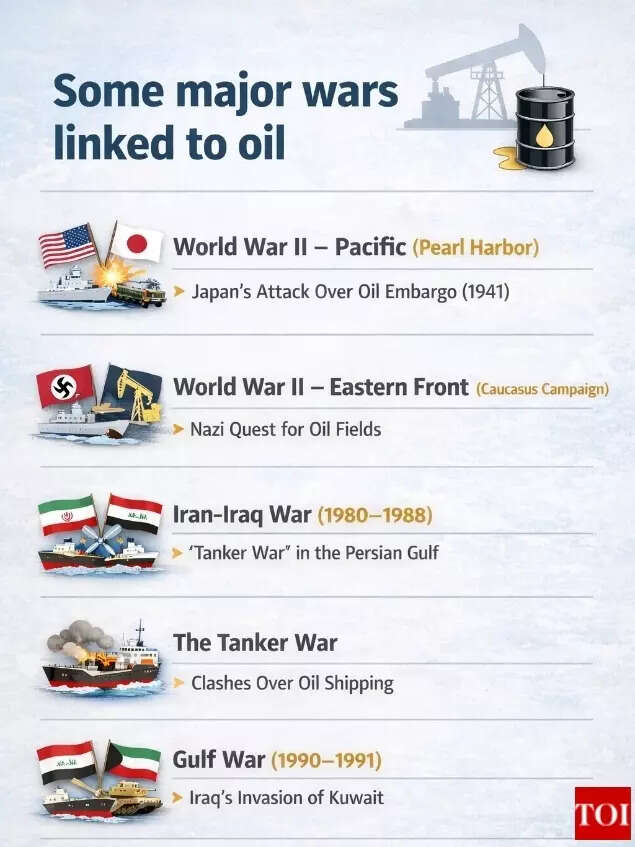
Historical conflicts show this reality, as explained by an article from an American international relations magazine The National Interest. Japan’s decision to attack the US at Pearl Harbor in 1941 was triggered in large part by an American-led oil embargo that threatened to cripple its navy and air force. Similarly, Nazi Germany’s push towards the oil-rich Caucasus during World War II reflected Adolf Hitler’s obsession with securing fuel supplies for his war machine, a gamble that ultimately contributed to Germany’s defeat at Stalingrad when oil ambitions overextended military capacity.Oil has also influenced the wars in the Middle East. In the 1980s Iran-Iraq War, Iran and Iraq attacked each other’s oil tankers and export facilities in the Persian Gulf, thus called the ‘Tanker War,’ which saw the United States directly enter the conflict to safeguard oil shipping routes. Then in 1990, Iraq’s invasion of Kuwait, which was fueled in part by disagreements over oil production and access to resources, led to the Gulf War and decades of West Asian geopolitics.All these conflicts reinforce a recurring pattern; that oil has consistently functioned as leverage, shaping wars, alliances and international disputes, far beyond its role as a traded commodity.