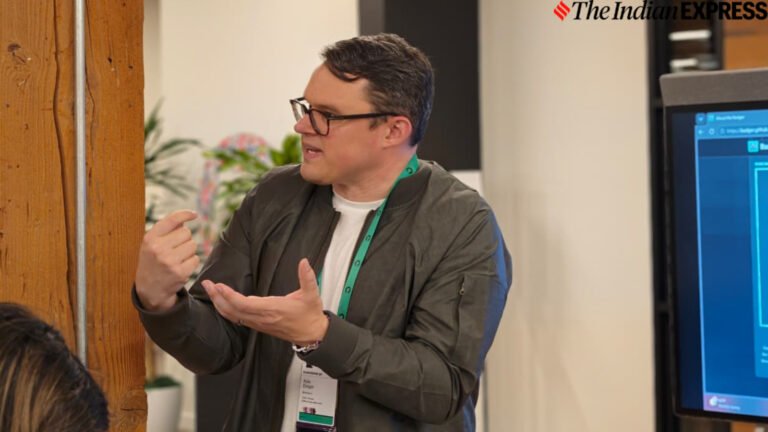
Developing economies need not reinvent the tech wheel: Co-Develop’s CEO Madhukar | Technology News

CV Madhukar is the CEO of Co-Develop, a global nonprofit fund accelerating the adoption of safe and inclusive digital public infrastructure (DPI) in developing economies.
It works with governments to identify appropriate technical solutions, support organisations developing digital public goods, and connect countries to larger sources of financing for people to benefit from better services and participate actively in the economy and society.
Madhukar has more than 30 years of experience in impact investing, policy, and scaling nonprofits. Earlier, as Managing Director, he led Omidyar Network’s global work on digital identity and DPI. His previous experience includes setting up PRS Legislative Research in India, and stints at Akshara Foundation, Azim Premji Foundation, Pratham and ICICI Bank.
He holds a master’s degree in Public Administration from the Harvard Kennedy School, an MBA from the University of Houston, and a Bachelor of Engineering degree from Bangalore University.
Madhukar spoke to indianexpress.com on the work done by Co-Develop, challenges of setting up DPI in various countries, the range of interventions, and how DPI is the foundation for AI readiness. Edited excerpts:
Venkatesh Kannaiah: Tell us about Co-Develop and what it seeks to achieve.
CV Madhukar: Co-Develop is a global nonprofit fund that helps countries develop digital public infrastructure. We help governments build shared digital systems that can support multiple public services rather than create separate and siloed tech solutions for every problem.
Take the case of digital identity, payments, and the exchange of information between institutions. These are capabilities that can be used across healthcare, agriculture, education, social protection and other areas. Once the underlying infrastructure exists, different government departments and service providers can build applications on top of it.
Our approach is that digital infrastructure should be reusable. If several countries face similar problems, they should not have to build the same software repeatedly.
We are not a technology vendor or an implementing agency. We are a funder and ecosystem builder. We try to identify gaps, bring the right organisations together, and provide the support needed to get things moving. We combine curation, convening and funding.
Venkatesh Kannaiah: Tell us about your impact so far.
CV Madhukar: We are working with 45 countries across Africa, Asia, Latin America and the Caribbean. Around 23 of these countries are in Africa.
They are at different stages in DPI implementation. In some, we have supported pilots. In others, systems have been implemented and are being used. The scale of adoption also varies.
For example, in Ethiopia, the government is developing its national digital identity system using MOSIP, an open-source identity platform. We did not fund the identity system itself, but we support organisations that are developing services on top of that infrastructure.
In Zambia, for example, digital identity verification capabilities have been applied to different use cases, including emergency assistance and health-related services. The principle is that once a country has a reliable identity-verification capability, it can use it in multiple programmes.
In Tanzania, Peru, and Trinidad and Tobago, we are supporting work on verifiable credentials. These allow documents such as educational certificates and licenses to be issued digitally and verified by whoever needs to check their authenticity. Education credentials are often the starting point, but governments can subsequently extend the approach to other documents.
We have also supported OpenCRVS, which provides open-source software for civil registration. Birth and death registration form the foundation for social protection, child welfare, and other services. OpenCRVS has helped several countries establish civil registration systems.
Beyond individual implementations, we helped establish the Centre for Digital Public Infrastructure at IIIT Bangalore in 2023. It provides technical advice to governments on how to architect their digital systems.
We have also supported work on inclusion and safeguards and helped convene a wider international community around DPI, apart from hosting the annual Global DPI summit.
Venkatesh Kannaiah: What is the focus now after your learnings?
CV Madhukar: First is on the economics of DPI. Look at how development banks finance digital solutions. The World Bank or the Asian Development Bank might provide loans to 20 countries to develop an agricultural solution. Each country then issues a request for proposals, hires a vendor, and builds its own system.
But the solutions may be nearly identical. We have been asking the World Bank why its financing model requires every country to rebuild essentially the same digital solution. Why should 20 countries build 20 versions of the same software? Could we develop one solution that 20 countries can adapt to?
We have discussed this with the World Bank, the Asian Development Bank, the Inter-American Development Bank and other institutions. They acknowledge that the existing model has limitations. The question is how to change it. Reforming established institutions is difficult, but recognising the problem is an important first step.
Second is about financing digital products, not just projects.
Development banks globally are project-financing institutions. You finance a large capital expenditure, provide a substantial loan and recover the investment over time.
But digital technology does not always work like a conventional infrastructure project. It is better understood as a product that needs continuous improvement.
You build something, learn from its use, modify it, adapt it and keep improving it. If you finance it as a conventional project, the process might take three years. You have to specify the requirements in the request for proposals on day one. By the time the system is built, the technology may have changed, and the government’s requirements may have evolved.
You could end up launching a system that is already outdated. We are therefore advocating that the World Bank and other multilateral development banks think about product financing rather than just project financing. They need instruments that support continuous development, adaptation and reuse.
Third is about creating a trusted repository of reusable digital assets.
Assume that the World Bank supports the development of a tech solution that multiple countries can use. But there is still a problem. A country may be reluctant to adopt software developed elsewhere unless it can trust its source and quality.
We therefore need a neutral and dependable repository of reusable digital assets. Countries should be able to go to a trusted source, identify a solution and use it without worrying that the repository is controlled by a particular country or captured by geopolitical interests.
If we want development banks to encourage reuse, we must answer a basic question: where is the trusted source from which countries can obtain these solutions?
We are exploring how such a repository might be established. It needs to be credible, accessible and sufficiently neutral that different countries and development institutions can use it.
Venkatesh Kannaiah: How has your experience at Co-Develop been in implementing DPI solutions?
CV Madhukar: One of the lessons is that developing technology is usually the easier part. Adoption, institutional coordination and making systems useful to people are much harder.
When we started, we thought countries could learn from each other and move quickly. The technology was proven at scale and there were implementation playbooks. But we have discovered that implementation takes time.
When a country’s leadership understands the objective and is prepared to coordinate institutions around it, progress is quick. Without that commitment, projects tend to flounder.
There is now a growing international ecosystem of organisations working on DPI. Governments, nonprofits, technology organisations, development institutions and multilateral agencies are collaborating. Countries no longer need to depend on one or two organisations for their technical support.
We need to help countries learn from one another while developing their own approaches.
Venkatesh Kannaiah: What aspects of India’s DPI experience are relevant to the developing economies?
CV Madhukar: First, India has demonstrated the value of shared digital foundations. Aadhaar, UPI and other digital systems have shown how common infrastructure can support different services and applications. It has also shown that digital infrastructure can be designed for the population at scale.
India’s G20 presidency in 2023 was also a landmark in bringing DPI to greater international attention. It helped put the concept on the global agenda.
But we must distinguish between learning from India and exporting an Indian blueprint. There is no one-size-fits-all approach. Developing economies want to analyse their own challenges and decide on their journey.
Venkatesh Kannaiah: What kind of DPI solutions could be useful in developing economies?
CV Madhukar: We first need to begin with the problem a government wants to solve and then identify the digital capabilities that can help.
Agriculture: Governments want to provide farmers with information on weather, market prices and agricultural practices. They also need systems to identify farmers and deliver input subsidies, output subsidies and other assistance. Shared agricultural infrastructure can connect these functions rather than requiring separate systems for each programme.
Government benefits and social protection: Countries need reliable ways to identify eligible beneficiaries and deliver payments.
Civil registration: Birth and death registration is foundational to many other services. Once implemented, civil registration can support social protection, child welfare and other public services.
Verifiable credentials: When someone applies for a job, an employer may need to verify several qualifications. Digital credentials allow institutions to issue documents that can be checked for authenticity. The same principle can apply to driving licenses, professional qualifications and other records.
Payments and financial services: Shared payment infrastructure can enable governments to transfer money more efficiently and help financial institutions offer new services.
These are common problems, but the solutions must still be adapted to local circumstances.
Venkatesh Kannaiah: What are the challenges you face when implementing DPI?
CV Madhukar: The first is the way governments have traditionally approached digitisation. Every department tends to build its own system. The health ministry builds one solution, the education ministry builds another, and the agriculture department builds a third. These systems may not communicate with one another.
The challenge is to move from thinking about individual applications to thinking about shared infrastructure.
The second challenge is institutional coordination. Even when government departments recognise the value of shared infrastructure, they may be reluctant to give up control over their own systems. There can be disagreements over budgets, responsibilities and access to data.
Third, financing mechanisms are not always suited to digital technology.
Fourth, countries may lack the technical and institutional capacity to design, implement and maintain shared infrastructure. Having access to software is not the same as having the ability to integrate it into government systems and use it effectively.
Finally, implementation takes time.
Venkatesh Kannaiah: How do you overcome these challenges?
CV Madhukar: We begin by working with the country to understand the problem it wants to solve. We do not arrive with a predetermined technology and ask the government to adopt it.
The Centre for Digital Public Infrastructure at IIIT Bangalore plays an important role. It helps governments think through their requirements, design an appropriate architecture and understand the available choices.
Once the problem and architecture are clear, we can identify digital public goods or other technology providers that may be suitable. The country can then decide whether to use an open-source solution or work with a proprietary vendor.
Our approach is technology-agnostic. We do not want to impose a solution on a sovereign government. We want to help it make an informed decision.
We also provide catalytic funding. The larger funding may eventually come from the government, the World Bank, the Asian Development Bank, or another development institution.
Finally, we support ecosystem development. That includes connecting governments with technical organisations, supporting research, encouraging peer learning and bringing different partners together.
Venkatesh Kannaiah: How does Co-Develop work with digital public goods providers?
CV Madhukar: Digital public goods are generally reusable software, often developed and maintained by independent nonprofit organisations. Some are specifically designed to provide foundational capabilities for DPI.
MOSIP, Mojaloop and OpenCRVS are examples of systems in this broader ecosystem. They are not products that Co-Develop itself created. Our role is to support organisations whose technologies can help countries address their needs.
But having reusable software is only one part of the equation. A country also needs to understand how that software fits into its wider digital architecture. If it simply installs another application without connecting it to the rest of its systems, it may create yet another silo.
Venkatesh Kannaiah: How is DPI related to AI readiness?
CV Madhukar: There is excitement about AI and the possibility that it will make services such as basic medical advice, agricultural information and legal assistance more accessible. But for AI to be useful, countries need relevant local data and systems that can work together.
If agricultural information is scattered across disconnected government departments, an AI application cannot easily provide a comprehensive service to farmers. Similarly, providing useful health advice requires relevant local information and appropriate safeguards.
This is why we believe DPI is foundational to AI readiness. Countries need to get their digital systems in order so that they can use AI effectively.
We are interested in identifying practical applications that work, rather than getting caught up in the hype. Agricultural information, including weather forecasts and market prices, is one promising area.
The objective is not simply to digitise more government services. It is to help countries build shared digital foundations that allow them to solve problems more efficiently and deliver better services to their citizens.